And What They Mean for Investments in Renewable Energy Today
I recently read an article, “6 Scientific Breakthroughs That Could Revolutionize Energy Production” (discoverwildscience.com). Although it is a fascinating look forward to upcoming advancements in energy production and storage, there are dozens, if not hundreds of articles on the same topic every day.
Yet, as new scientific breakthroughs in energy production make headlines, decision‑makers often face the same question:
What of this is relevant for a company planning or expanding renewable energy systems today?
And more importantly:
Which developments should already influence the long-term design of an energy system?
A recent overview of six major research breakthroughs highlights a clear message:
While many technologies are still in early stages, their direction is unmistakable — and highly relevant for businesses aiming for resilient, future‑oriented energy concepts.
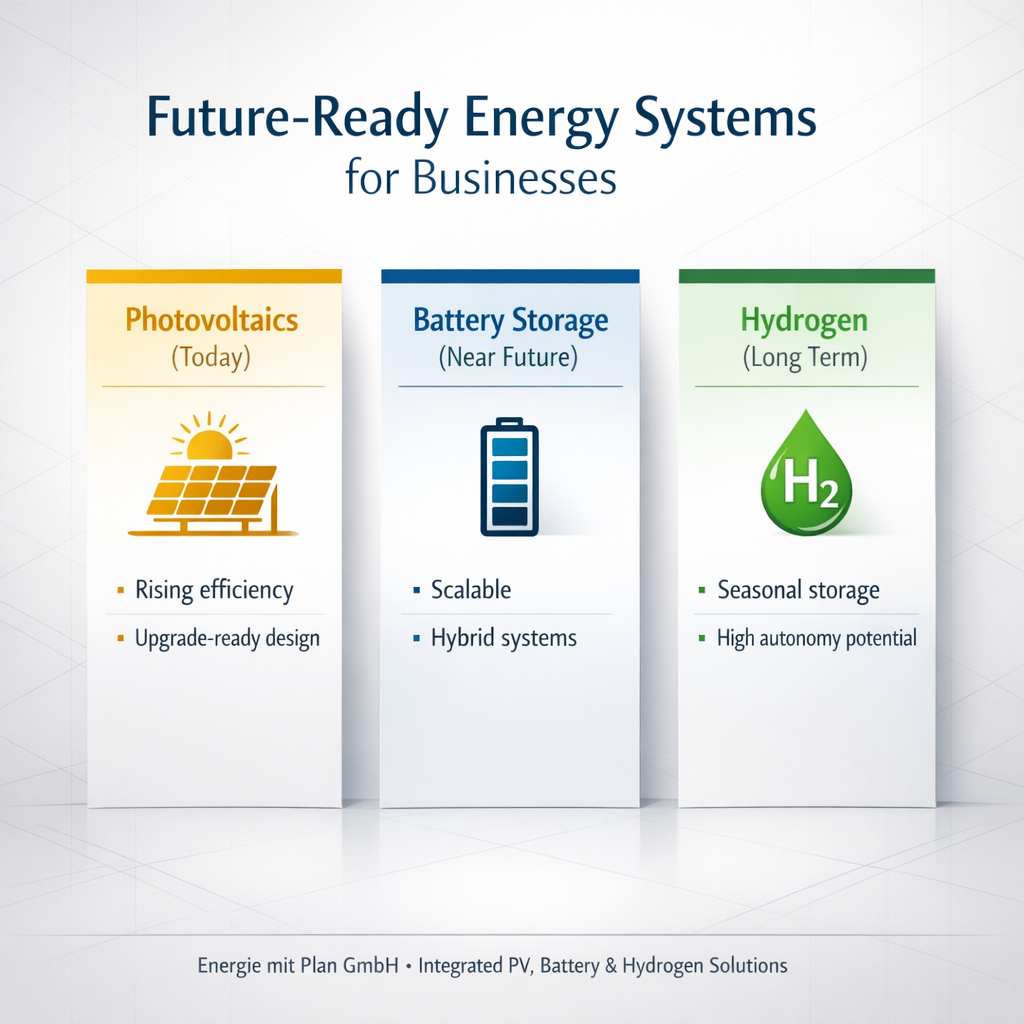
There are three developments that every investor in renewables should keep in mind:
1️⃣ Solar breakthroughs point toward higher yield per square meter
New materials — especially high‑efficiency perovskite and tandem structures — are making rapid progress.
For companies with limited roof or site area, this trend matters today:
A well‑planned PV system should already anticipate future module upgrades, whether through adaptable mounting systems, optimized string layouts, or scalable electrical design.
Planning for flexibility today protects investment value tomorrow.
2️⃣ Advances in battery research strengthen the case for hybrid systems
Next‑generation storage — such as solid‑state batteries, sodium‑ion cells, and advanced lithium chemistries — aims for higher efficiency, longer lifetime, and improved safety.
Even if these technologies are not yet widely available, the trend is highly relevant:
- PV systems should be designed so that storage can be integrated smoothly later.
- Electrical infrastructure (cabling, load distribution, EMS compatibility) should be battery‑ready.
- A scalable approach prevents costly redesigns as storage prices decrease and technologies mature.
Well-designed hybrid systems increasingly become the norm, not the exception.
3️⃣ Hydrogen technologies are becoming more efficient and more practical
New electrolyzer concepts, improved catalysts, and alternative hydrogen storage methods signal accelerating progress.
While hydrogen systems for commercial and industrial sites are still evolving, the implications for long-term planning are clear:
- Seasonal storage will become more accessible as efficiencies improve.
- Hydrogen can complement PV and battery systems where winter demand or grid constraints require deep autonomy.
- Designing energy infrastructure with future hydrogen integration in mind — even if not installed immediately — can prevent expensive structural changes later.
Hydrogen may not be the first step, but it is increasingly becoming part of the long-term roadmap.
What this means for decision‑makers
The technologies of tomorrow should not delay investments today.
But they should influence system design.
A future-proof PV concept considers:
- the ability to upgrade to higher-efficiency modules later
- the option to integrate or expand battery storage
- the possibility of linking PV and storage with hydrogen systems in the future
- an energy management system capable of orchestrating all components intelligently
Future breakthroughs will not replace today’s proven technologies — they will amplify the impact of systems built with foresight.
🌱 Energie mit Plan’s Commitment to Customers and Partners
We plan and install photovoltaic, battery and hydrogen systems that deliver strong performance today — and remain adaptable as new technologies mature.
If your company is evaluating a PV expansion or planning a new system, we are ready to support you with a concept that is technically grounded, economically sound and future‑proof.
#SolarEnergy #PVSystems #EnergyStrategy #RenewableEnergy #BatteryStorage #Hydrogen #Sustainability #EnergyManagement #FutureEnergy
