You Are Not Alone.
If your company is anything like mine, you’ve probably felt the shift. Automation isn’t some future concept on a strategic slide anymore — it’s something many teams are actively trying to build into their daily operations.
We’ve seen the promise:
- fewer repetitive steps,
- less admin,
- more time for meaningful work.
But getting there often turns out to be much harder than expected.
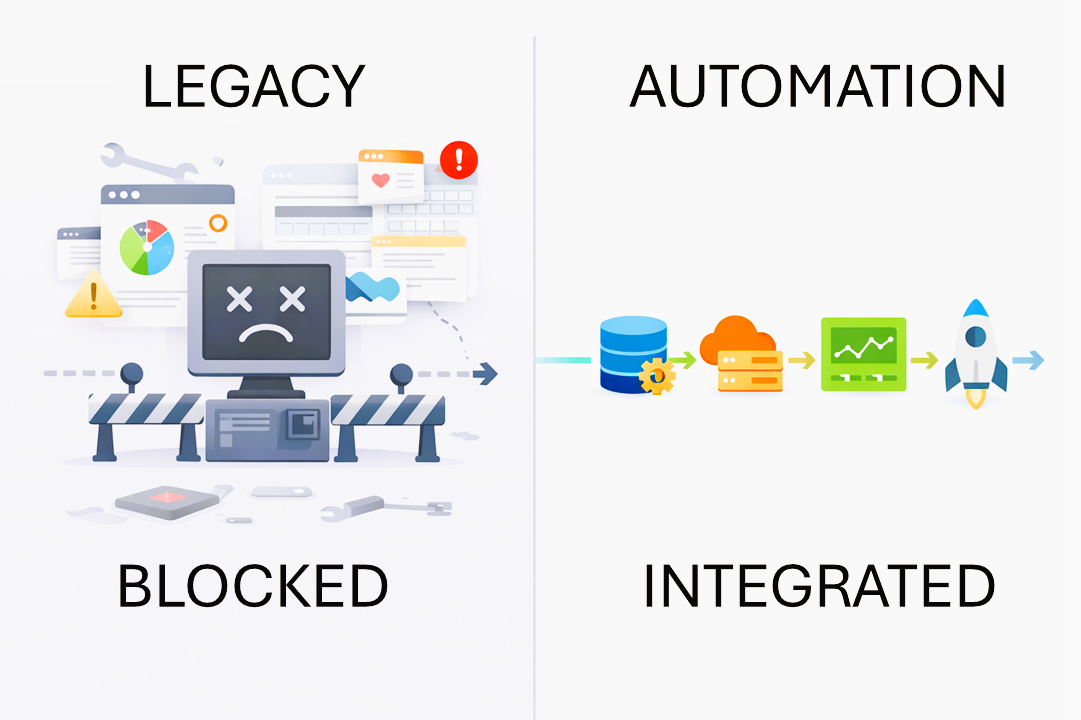
In our case, the biggest obstacle wasn’t strategy, budget, or motivation. It was software — specifically, a tool that simply can’t integrate with anything else. And the more people I talk to, the clearer it becomes that we’re far from the only ones facing this issue.
It’s understandable when you look at how most organizations grew. Tools that once solved a very specific need became part of the company’s muscle memory. People learned them. Processes formed around them. They became “the way things are done.”
But as soon as you try to modernize those processes, those same tools suddenly become immovable. Not because they’re bad products — some were genuinely excellent for their time — but because they weren’t built for today’s world, where every system relies on at least some degree of connectivity.
And that’s the world we’re operating in now.
Real automation doesn’t happen inside a single tool. It happens between them — one system pushing updates, another pulling data, a third triggering a follow‑up action. AI agents and workflow tools aren’t looking for clever features; they’re looking for places they can hook in. When even one system remains a closed box, everything else stumbles.
You can usually spot the symptoms long before anyone calls them out. Someone exports data because two systems can’t talk. Someone else pastes the same numbers into Excel so they can be imported elsewhere. A project manager re‑enters customer details into a reporting tool because the billing system won’t share them automatically. None of these things feel dramatic in isolation, but together they become the invisible tax everyone pays.
And here’s the real sticking point:
- If a system can’t integrate, it can’t participate in automation.
- If it can’t participate in automation, it becomes a barrier every time you try to improve anything downstream.
For us, the turning point was simply acknowledging it. Saying, “This tool is holding us back,” made everything clearer. Once we knew the source of the friction, we could evaluate which tools could adapt and which ones never would. It also led to far more honest conversations with vendors — and gave us the confidence to replace systems that weren’t built for the future we’re trying to create.
If you’re dealing with something similar, you’re not alone. A lot of companies are navigating this exact transition. And while it can be messy, it’s also an opportunity — a chance to rebuild your setup in a way that actually supports the work you’re doing today, not the work you were doing five years ago.
——————————-
#BusinessAutomation #SystemIntegration #LegacySoftware #AIForBusiness #ProcessOptimization #EnterpriseSoftware #OperationalEfficiency #Interoperability #TechnicalDebt #DigitalWorkflows #ThoughtLeadership #AIAutomation #DigitalTransformation #AIIntegration
