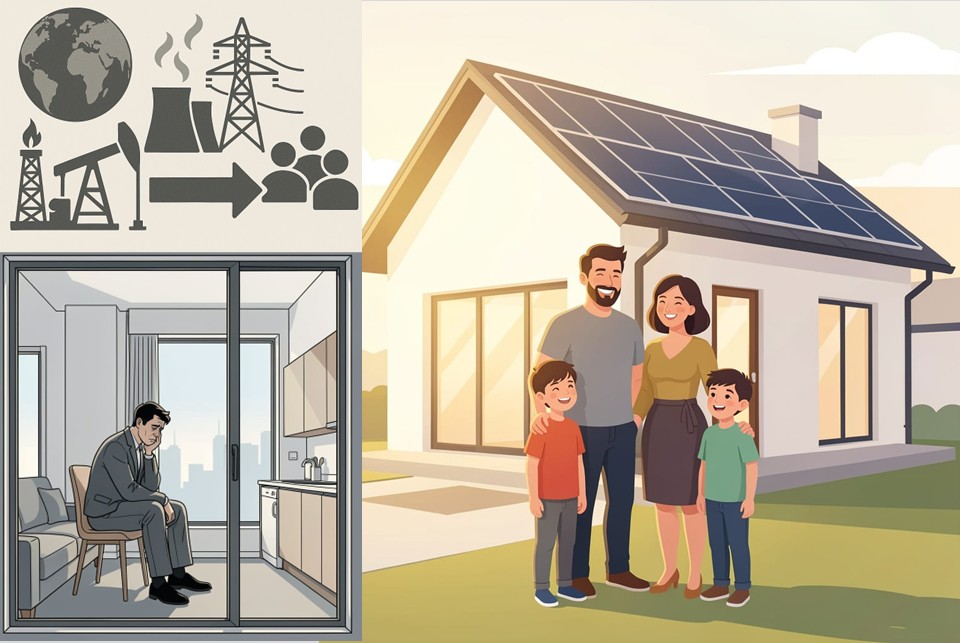
👉 In Part 1, I argued that fossil fuels make consumers and businesses vulnerable by their nature — not because of bad intentions, but because oil and gas are global commodities, priced globally and controlled by a small number of powerful actors.
That leaves us with a practical question:
Is there an energy model that reduces exposure instead of increasing it?
This is where renewables change the equation.
Think of it this way.
➡️ Fossil fuels are like renting an apartment.
You pay regularly, but the price can change at any time — for reasons completely outside your control. You are also not free to do much remodeling to suit your own tastes
➡️ Renewables are closer to home ownership.
There’s an upfront investment, but once it’s made, exposure to external price shocks drops sharply. Costs don’t disappear — but predictability and control increase. You can also remodel to your own needs or tastes.
That shift alone changes the risk profile of an energy system.
👉 It also explains why governments are accelerating renewables — quietly and pragmatically.
China, the United States, and Europe are all expanding solar and wind not because it “sounds good,” but because domestic generation:
- reduces exposure to global shocks
- improves planning certainty
- and strengthens resilience
This isn’t (merely) ideological – It’s risk management.
Renewables don’t eliminate global markets — but they reduce how much you depend on them.
❗ Every kilowatt‑hour produced locally is one you don’t buy at volatile prices, one less affected by geopolitics, and one less exposed to corporate pricing decisions.
What’s really changing isn’t the fuel—it’s the relationship.
It’s from renting energy to starting to own it.
👉 In Part 3, I’ll look at why solar is the most practical entry point — and why waiting no longer makes sense.
Content Creation💡Conceived and directed by me, 📝 in collaboration with AI
#EnergyIndependence #RenewableEnergy #EnergySecurity #SolarPower #SMEs #RiskManagement #EnergyTransition
